Sunday, October 2, 2011

Year of Service Interview: Australia

The following is the first of many interviews to come with other youth around the world who have been on a year of service. I post these interviews specifically for other youth contemplating doing their own year of service who don't know yet where they want to go or if they should go. The interviews hopefully shed light on some of the questions that arise for those seeking the life-changing adventures that a year of service can offer.

The Baha’i youth featured in the below interview chose to serve for a year in Australia. She is now in college and serving her community in Colorado. I know you will enjoy her comments and insights into the true meaning of service.


Youth serving at the House of Worship in Australia

1. What drew you to Sydney, Australia as a place to serve?
When I was looking for places to serve, I really wasn’t set on anywhere specific. I knew I wanted to go internationally, but I didn’t know where. So I started with Google, and looked up “Baha’i youth year of service”. As I was reading through the lists, Australia just seemed to keep popping up. So the more I thought about going to Australia, the more I liked the idea. I looked online at the Australian Baha’i National website, and found the application, and applied. The next thing I knew I had a phone interview and was accepted to serve. I felt that it being such a smooth process was a confirmation of my choice to go to Sydney.

2. How has your life changed as a result of service?
Everything about my life changed after my year in Australia. After high school, I needed a break from school, and I had heard so many wonderful stories from friends that had done a year of service, and how life changing it was for them. I had no idea what I was getting myself into, but I decided to take the risk and travel all the way across the world by myself. By being able to dedicate my full time to service, I was able to see the true necessity of a community based on service to each other. Since I was at a Baha’i House of Worship in Sydney, I was able to pray there every day and contemplate about my life and future. As my year in Australia drew to a close, I realized how much I had grown in that year and become more aware of my own personal strengths and weaknesses. Also, being able to travel outside of the country I had grown up in gave me a better view of the world around me.

3. What was the greatest test you faced and how did you overcome it?
For me I didn’t really have one big test that I had to overcome. There were some conflicts that arose while being in a small house with seven other girls, but those were resolved through communication and organization. I guess another thing that was stressful for me was the fact that my plan for school after Australia completely changed while I was there. So instead of knowing exactly what I was doing when I got back to the U.S., I had to figure it out while I was still in Australia. In retrospect, it doesn’t seem like a huge test, but I know while I was there it was definitely stressful.

4. What was your happiest moment on your year of service?
I distinctly remember going into the House of Worship by myself at night, and just the feeling of peacefulness and serenity I will never forget. Being able to go and say as many prayers as I wanted, and just being able to feel that spirit was such a beautiful thing. I can remember a specific time when my service had reached an especially stressful point, and I went and said the Tablet of Ahmad on each of the nine sides. As I continued to pray I could feel my worries and fears just melt away.
To be continued….

Sunday, September 25, 2011

Camping in Canyon de Chelly

Unless guided by a Navajo or certified park guide, all visitors to Canyon de Chelly must be satisfied with a drive along the top of the canyon and stops at overlooks, each of which are striking and breathtaking in beauty. Thanks to a Navajo Baha’i family with land in the canyon, a few NABI staff and volunteers had the bounty of spending a night in the canyon.


Spider Rock, home of Spider Woman, who taught the people how to weave

A few of us hiked down while others drove in with a truck loaded with food, water, and tent gear. Those who hiked experienced a rubble-strewn and occasionally steep trail which bottomed out and followed a creek bed along the canyon’s base. The creek bed was overgrown with tamarisk and Russian olive, and Western Bluebirds flew over our heads in small flocks as we walked. A Red-tailed Hawk let out a scream, no doubt sitting on a canyon ledge, the rust red of its tail complimenting the terra cotta canyon walls. As we walked along our guide pointed out the dark streaks along the canyon walls, called desert varnish. The Navajo say these streaks are the canyon’s hair. Our guide told us that if a girl washes her hair in the water which collects in the natural wells on the canyon top, it is said her hair will grow long like the canyon’s.


After setting up our tents, another volunteer and I played our flutes at different points near the campsite. The sound of our flutes echoed across the canyon. Then we all had a dinner of Navajo tacos (after learning how to make fry bread). And of course, we made s’mores. Anna Feria, programs coordinator at NABI, taught us to make chocolate bananas over the fire (see instructions below). We spent the night singing and talking as the moon cast its warm glow over the canyon walls. Now that’s what I call a perfect night, spent with kindred spirits. :)


I’m Buildin’ Me A Home (part of a song we learned at trainings in Pheonix):

If you see me praying
I’m buildin’ me a home
Well if you see me praying
I’m buildin’ me a home
Cuz this earthly house
Is gonna soon decay
And I’ve got to have
Some place to stay


Rae and Nani at the campfire


* How to make a chocolate bananaphone! Perfect for camping trips (could be used in junior youth group activities, especially sleepover events). It may be helpful to place a grill over the fire, although the bananas can be placed directly on coals. Cut banana on the inside of the bend to create a space where you can wedge chocolate chunks inside. Use broken up Hershey bar or other chocolate to place inside the cut. Wrap banana in aluminum foil (do not take the skin off!) and place over fire or coals. Let cook until chocolate is melted on the inside. Use spoon to scoop chocolate-banana gooeyness out of the skin.

Poem: Morning Prayer


See the sun rays through the clouds,
The distant and misty rainbow.
Hear the gentle pitter-patter of the rain,
The thump of jackrabbit's over-sized feet,
Like a heartbeat against the Earth
As he races over the red-clay land.
Smell the dampened sage,
Let the sticky clay cling lovingly
To your humble sandals
Which have walked so far.

Now let us pray with radiance:
Creator, give this yearning heart
Hope to carry forward and courage
She is certainly the weakest creature
In this dust-ridden land
And like dust, will one day be blown
By the unexpected storm to
Far-away places

We grow with pain
Our souls thrive
After being uprooted
So give her detachment
From all things
Even the home
Even her dreams

She has become the eagle
Which soars over vistas and canyons
The beloved sun illuminating her wings
As she longs to come closer to its
Warming rays,
She is nearing its radiance
Yet infinitely far from the object
Of her desire.

Yes, her body is a hindrance
A mere cage
From which the bird of her soul
Longs to break lose
And stretch its wings

Let us pray with radiant yearning:
Illuminate our every action
O True Friend
We will all return to beauty
Hozho nahasdlii
Hozho nahasdlii
Hozho nahasdlii
Hozho nahasdlii

Thursday, September 22, 2011

Artwork!!

Both need a lot of improvements, but here they are, from a girl who used to think she couldn't draw humans at all:

Navajo girl, watercolor

Radiant drummers, pen and ink

Tuesday, September 20, 2011

Navajo Nation Fair: Song and Dance

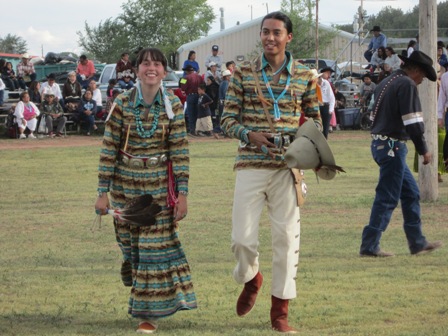
A Navajo woman dresses herself starting from her feet and working upward to her head, the way corn grows, from the soil to the sun. I keep this in mind as I wrap the buckskin moccasins around my ankles, smoothing out the folds and tying the ends midway up my calf. Then the bracelets and rings, right arm first and then the left. Then the necklaces and turquoise earrings. Nanabah, the junior youth coordinator, fixes my hair in an imitation bun, since my hair is not long enough to be tied in a true traditional bun (called a tsiyeel). After at least thirty minutes of getting dressed, we are finally ready to leave for the Navajo Nation Fair in Window Rock, where fellow volunteer James Foguth and I will dance in the annual song and dance competition.


The Navajo song and dance has its origin in the Enemy Way ceremony, a type of healing ceremony for Navajos returning from war. The dances are of two kinds, two-step and skip step, and require a partner. Typical female wear for such dances includes a long skirt and top, lots of jewelry, a sash and a concho belt. In participating in these dances, I learned a great deal about the importance of jewelry in Navajo culture. Often times the jewelry pieces are heirlooms passed down through generations. The squash blossom necklaces and turquoise-studded wrist cuffs have a memory accumulated through years of being worn in sacred ceremonies and dances. Thus when one dances, blessings and prayers are added to the memory of the objects being worn.

At first, the dancing was easy and the hours of practice spent in the previous week started to pay off. But the event spans over two days, and after an hour I began to feel the ache in my legs. Then I remembered something my flute teacher, Robert Talltree, had told me during a flute lesson. Sometimes when one is playing the flute for long periods of time it’s easy to get tired and lose the original energy which a song started out with. And sometimes that energy is regained in a second burst, like a horse receiving its second wind during a race. I thought of this as I danced, and thought this could be true of physical activity as well. I prayed, and thought of all the community effort which made it possible for James and I to even be participating in this event, and then I thought of all the Baha’is around the world engaging in community building processes just like the Native American Baha’i Institute. These were thoughts that gave me a second wind as I danced.


Forty-six pairs participated in the song and dance event, dressed in their best traditional outfits, from velveteen skirts to shirts trimmed with jewelry and silver buttons. We danced for at least 12 hours (with breaks every eight songs or so). The experience was reward enough for me, but you probably want to know how we placed: James took first place in the youth category for male best dressed and we both went home with first place for two-step in the youth category.

The greatest lesson learned from this experience was a community’s ability to band together and turn an idea into a reality. It began with an idea from Alice Bathke, who mentioned the fair on the car ride home from a children’s class in Fort Defiance. James started talking about the song and dance events and pretty soon we were buying fabric for our outfits and asking Charlotte Kahn to sew the outfits. Alice lent me her wrap-around moccasins* and jewelry, Nanabah lent me her jewelry and hair-dressing skills, and Rosemary, the cook for Thursday night community dinner, lent me her jewelry. Jon Fransisco, a local Baha’i, taught James and I the two-step and skip step on Thursday nights after community dinner. The community took two youth who had never participated in a song and dance before and nurtured them in a short amount of time (literally two weeks) until they had reached a new level of capacity, which involved dancing in a fair event. Now imagine the potential this Houck community has in spiritually transforming not only itself but the areas which surround it. When all work in unity for a common goal, the possibilities are limitless.

At one point during the two-step I looked up to the sky and was fascinated by the storm clouds progressing our way. In that moment my soul was an eagle longing to soar high in those clouds, and this physical body a mere limitation. All the confirmations of service descended upon me and I felt like there was no dream I couldn’t make come true. If there are any young people, especially female, out there reading this blog there is one thing I want them to take from this blog: if there is an adventure you have been dreaming to have, there is nothing but yourself to stop you from making it into reality. You have your prayers, the world community, and your own volition which, when combined, are an invincible force aiding you to make things happen. All doors are opportunities. Some may be shut, even slammed in your face, but with perseverance and reliance upon the Creator, you will find confirmations which surpass your wildest dreams.


*The style of wrap around moccasins has its origin in the historical Long Walk from Canyon de Chelley to Bosque Redondo. The moccasins consist of buckskin moccasin (usually red-brown) and white buckskin straps that wrap around up the calf, in some cases to the knee. They were designed to protect women from thorns and snake bites during the Long Walk.

Saturday, August 6, 2011

A Post for Naturalists


Path to the Prayer Hogan. Hogans are traditional eight-sided Navajo structures, with the door always facing East.

The habitat surrounding The NABI campus consist of piñon and juniper, sagebrush, with maybe three deciduous trees on the campus itself. It is often dry and the ground sandy, except for this time of year when monsoon rains flood the washes and turn the sand to mud and clay. Looking out over the land, the primary colors are green and brown, and once in awhile there are bursts of red and purple prickly pear blossoms. To a passerby, it might seem gray and dreary. Even the birds reflect the colors of their habitat: Gray Vireo, Gray Flycatcher, Black-throated-gray Warbler. There are sandy colored Canyon Towhees and dusky gray Juniper Titmouse.

Not all the wildlife, however, is devoid of color. The colorful side of piñon/juniper habitats must be searched for and found over time, perhaps not in a day, or even a week, but after many months of being aware of one’s surroundings. Driving along the wash-board dirt roads one might catch a glimpse of the canary yellow of a Scott’s Oriole, or the tangerine orange of a male Bullock’s Oriole in migration. In late July and August, Rufous Hummingbirds with shimmering red gorgets cluster around birdfeeders on their way to Central America. If one is lucky enough to get a close look at the fast-moving Black-throated Gray Warbler, even they have a speck of sunshine yellow on their lores.

But besides color, the land is also full of unusual life forms: horny toads, hummingbird moths (sphinx moths) which hover over tube flowers at dusk and sit on window screens during the day, and alien-like cicadas which buzz like miniature chain saws throughout mid-summer and leave behind husky skins which they have shed.

Perhaps my favorite wildlife memory at NABI is the howling of coyotes as they throw back their heads and release their high-pitched voices. It is an eerie sound, they are the ghosts of the land which hide in the washes during the heat of the day and come out around sunset.

For the birders out there who might be reading this blog, here is a list of birds seen on the NABI campus and some of the nearby dirt roads:

White-faced Ibis (closer to Sanders)
Turkey Vulture
Red-tailed Hawk
Swainson’s Hawk
American Kestrel
Mourning Dove
Eurasian-collared Dove
Broad-tailed Hummingbird
Rufous Hummingbird
Northern (Red-shafted) Flicker
Hairy Woodpecker (a single bird)
Gray Flycatcher
Say’s Phoebe
Ash-throated Flycatcher
Western Kingbird
Gray Vireo
Western Scrub-Jay
Common Raven
Barn Swallow
Juniper Titmouse
Bushtit
Bewick’s Wren
Blue-gray Gnatcatcher
Western Bluebird
Northern Mockingbird
Black-throated Gray Warbler
Yellow-rumped Warbler
Western Tanager
Spotted Towhee
Canyon Towhee
Chipping Sparrow
Lark Sparrow
Bullock’s Oriole
Scott’s Oriole
Western Meadowlark
Brown-headed Cowbird
House Finch
Lesser Goldfinch
House Sparrow (kinda goes without saying)

Sunday, July 24, 2011

Hózhó Naashá Week

Many Children Learn to Walk in Beauty


With 36 to 55 children in attendance and no less than ten adults assisting at any given time, the Hózhó Naashá children’s camp hosted on the NABI campus proved a success. This four day long children’s day camp provided for the spiritual education of children ages five to ten, using the teachings of the Baha’i Faith and Navajo spiritual traditions, which go hand in hand. In the words of Ellen McAllister-Flack, the coordinator for the camp, “I have been thinking for a long time about the relationship of Navajo spiritual, cultural tradition and how many of them are in line with the Baha’i Faith. This children’s program was an opportunity for exploring that relationship.” The camp was characterized by three Navajo Blessing Way themes: Há áhwiinit’í(be generous), Ahééh jinízin (Be appreciative), and Házhó’ó ajinízin (Be a careful listener). These three values are also celebrated in the Baha’i Faith as attributes of God which humans can reflect in their actions and service to others.

The children participated in an array of activities from learning prayers in Navajo to creating paper cradleboards. Adults supervised activities like beading, weaving, nature walks, drumming, and sports. The group was fortunate to have an elder from Houck, Mr. Chester Kahn, share with the children the importance of the eagle feather and the eagle as a symbol of strength, the one who carries our prayers to the Creator. The children sat attentively before Chester on colorful mats, practicing one of the three Blessing Way themes which the camp emphasized: Házhó’ó ajinízin, be a careful listener.


Among the children were a handful of junior youth between the ages of 11 and 15. Although initially unsure of their role in the program, they quickly found their place as counselors to the younger children. A brief training was offered for them on their role as mentors to the children. They did not hesitate to assume the responsibility of leaders as they guided a group reflection, asking the children which parts of the day went well for them. Counselors supervised the playground and group activities, showing us their true colors as noble beings eager to serve and uplift the children in their community.

Baha’u’llah says “Regard man as a mine rich in gems of inestimable value. Education can, alone, cause it to reveal its treasures, and enable mankind to benefit therefrom.” Each child is a mine of virtues, such as kindness, love, joy, generosity, and unity. Children who attended the camp were encouraged to see their Navajo culture as one of these many gems which lay within them. In one activity, children were taught basic principles of showing appreciation. As they passed an eagle feather around the room, each person learned to say thank-you in Navajo: Ahéhee'. In another activity they read a story on the equality of all human races, whether black or white, red or tan. Throughout the program they were taught the importance of prayer and the proper attitude when praying: we must sit quietly when we pray, for we are talking to our Creator. Among the prayers learned was a simple Baha’i prayer translated into Navajo:

Diyin Nílíinii, shi Diyin, shi Ayóó o’ni’, shijéí Yínízinii.
(He is God, O God, My God, My Beloved, My heart’s desire.)

Ellen McAllister-Flack, a trained educator with many years experience, says “this is the beginning of letting young people know that who they are and where they come from has valid moral teachings and that if they become Baha’i or recognize Baha’u’llah they bring these with them.” The Hózhó Naashá children’s camp served the greater purpose of bringing the community together through child education. In communities around the world, children are the hope, the ones to whom the future belongs. Hózhó Naashá Week was one of many steps in a process of community building through the spiritual education of children.

The day camp has opened the door to holding children’s class at the neighborhood level. Already, NABI staff and volunteers have held classes at homes in Querino, Houck, and Sanders with children who attended Hózhó Naashá week.

Note: Some of the letters used to write the Navajo words are incorrect and lacking in certain accents. My apologies, I was unable to use the right type of font on this blogging site. I have done my best using the accents available in Times New Roman.