So here I write, about five months after the end of my year of service. I was asked to give a short presentation at a Colorado Springs community feast, so I thought I'd use this space to reflect and also bring closure to the blog (though it will always be open as a resource for other youth wanting to go on a year of service).
Perhaps the greatest lessons I learned had to do with social skills and learning to live and work in unity with others. When I find myself in disagreement with others, I've learned to just take a deep breath and let it go. Let it go, be detached, those are the phrases I've had in my head the last few weeks. If we allow ourselves to be beaten down by all the sour things in life, we're in for one helluva bruising. I've found that I'm stronger then I think I am, with a long way to go of course. The words and actions of others can be hurtful, but you can't change what has already happened, only how you handle it.
I've also learned about trust, trust in the Creator, trust in the power of prayer, and trusting that things will generally be alright.Our actions determine the success of an endeavor, but prayers are like a little wind in the sails. Prayers bring confirmations and remind us that we don't have to do anything completely alone.
This semester, I've had the full range of emotions from joy to discouragement. The college culture is alcohol and drug-centric, and I sometimes feel I'm living in upside down world. But the important thing is not to be disillusioned, to remember all humans are created noble and to continue to search for the spiritual food for which the entire world is hungry. I have perhaps most importantly realized upon my return that a "year of service" is just a term, that the journey I have been embarking on is in fact one of a life of service. And the things I've learned this semester, both in school and in the local community, have been equally as life changing. I'm certainly not the same person I was in January 2011, or January 2012. We are always changing, always growing....
Sunday, May 20, 2012


Friday, May 18, 2012
Year of Service: Jamaica (4)
Post 4:
The After-Story
During his time in Jamaica, Josh became close with another year of service volunteer from New Zealand. At the end of his service, Josh decided to visit New Zealand himself and visit his partner in service. Josh stayed with a friend whose parents owned a mansion overlooking the bay of Auckland. The contrast with Jamaica’s abject poverty was shocking. Truly it was “the other extreme of existence.” Josh had his own room with a bathroom and towel warmer, fresh bread and jam every morning, and a marble-lined swimming pool. He stayed in Auckland for two weeks then visited Wellington, where he stayed in a college flat with seven other people for two weeks. Back in The United States, Josh noticed a lack of color compared to Jamaica and New Zealand. To him, the American scenery was filled with neutral browns. However, it was nice to have warm showers and food available. In Jamaica, Josh would save up just to have a bowl of rice and chocolate soymilk and would take showers with a cup out of a five-gallon bucket. Cultural differences also became apparent. Unlike in The States, Jamaicans were friendly regardless of the personal danger. “You could sit next to anyone and have a great conversation with them.” His year of service, Josh reflects, provided the opportunity to open his eyes and develop many qualities. “It’s different when you’re focused on doing things for people all day, every day, with no opportunity to worry about your own life or situation.” For those who do not get a chance to embark on a year of service, “it is a huge loss in their life.”
Okay peoples, I want your stories! I know there are youth out there who have lived epic spiritual adventures and aren’t writing it down for future generations. Perhaps you are not a writer, in which case I am offering with all the eagerness I can muster to write it down on your behalf. I would love, love, love to be of service in helping you record the experiences, lessons, and stories of your year of service. Contact: mokeysue01@comcast.net
The After-Story
During his time in Jamaica, Josh became close with another year of service volunteer from New Zealand. At the end of his service, Josh decided to visit New Zealand himself and visit his partner in service. Josh stayed with a friend whose parents owned a mansion overlooking the bay of Auckland. The contrast with Jamaica’s abject poverty was shocking. Truly it was “the other extreme of existence.” Josh had his own room with a bathroom and towel warmer, fresh bread and jam every morning, and a marble-lined swimming pool. He stayed in Auckland for two weeks then visited Wellington, where he stayed in a college flat with seven other people for two weeks. Back in The United States, Josh noticed a lack of color compared to Jamaica and New Zealand. To him, the American scenery was filled with neutral browns. However, it was nice to have warm showers and food available. In Jamaica, Josh would save up just to have a bowl of rice and chocolate soymilk and would take showers with a cup out of a five-gallon bucket. Cultural differences also became apparent. Unlike in The States, Jamaicans were friendly regardless of the personal danger. “You could sit next to anyone and have a great conversation with them.” His year of service, Josh reflects, provided the opportunity to open his eyes and develop many qualities. “It’s different when you’re focused on doing things for people all day, every day, with no opportunity to worry about your own life or situation.” For those who do not get a chance to embark on a year of service, “it is a huge loss in their life.”
Okay peoples, I want your stories! I know there are youth out there who have lived epic spiritual adventures and aren’t writing it down for future generations. Perhaps you are not a writer, in which case I am offering with all the eagerness I can muster to write it down on your behalf. I would love, love, love to be of service in helping you record the experiences, lessons, and stories of your year of service. Contact: mokeysue01@comcast.net
Wednesday, May 16, 2012
Year of Service: Jamaica (3)
Post 3:
Awesome and Horrible Extremes
The contrast between positive and negative aspects of Jamaica, in its culture and environment, were striking to Josh. On one hand, there was no running water, no windows (just holes in the wall), and “an outrageous amount of bugs”. The mattresses were sometimes sloped and uncomfortable. Mosquitoes and cockroaches abounded. As Josh puts it, “The floor would be crawling with cockroaches.” At the same time, he considered Jamaica a paradise. He lived on a college campus, which was heavily guarded by men with machine guns. Once past the guards, however, there was a trail which led to a quiet beach. Jamaicans hate water, leaving Josh with the beach to himself. He would sometimes buy a chicken patty and coke on the way to the beach, then sit in a hammock and watch the sun go down. There was an outcropping of coral reef with a few palm trees which were silhouetted against the sunset. He would later tell his mother, “I think I finally learned how to meditate.”
Culture
Years of missionaries giving material goods freely to locals created, over time, a culture of stealing in Jamaica. If things are left in the open, an individual feels obligated to steal it, regardless of their economic status or education. Even people one would not expect to steal, someone well-dressed and well-educated, would steal.
On another trip to Kingston while Josh waited at the taxi hub, a man blatantly attempted to pick-pocket Josh. Josh refused to hand over his wallet and the offender pulled out a knife. A second man appeared, also with a knife. Again Josh refused to give-up his wallet. Both men attacked with their knives, where were so dull that they only left temporary red marks. Eventually, Josh gave the two men his money but kept the wallet. At that point, Josh had no money to pay for a taxi back to Port Antonio. At this time several school girls around age 11 dressed in uniform approached and asked Josh if he needed money, which he desperately did. They contributed enough for him to catch a taxi back to Port Antonio.
“It’s amazing what you can get used to” Josh says when reflecting upon the dangers he was surrounded by in Jamaica. Josh’s year of service coincided with the Jamaican election year, a time of great turmoil. The party in power controlled the militia and the party wishing to be in power controlled the gangs. During another Kingston trip, while visiting the Baha’i National Center, there was a “full-out auto-machine gun fight” and the National Guard appeared to get things under control. It was like a scene “straight out of the movies”, and there was nothing to do but turn off the lights and lay down on the floor until all was safe again.
His most frightening experience, however, was not being robbed by knife-point or the political upheaval. Rather, it was his first ride in the car from the airport. The roads have no shoulder, sometimes with a cliff face on one side and a cliff drop on the other, and are riddled with potholes which drivers swerve to miss. At all times there are pedestrians and bicycles to add to the confusion. Later in his year of service he realized how blasé he had become about walking on the hectic roadsides. “Jamaicans are really good drivers” he explains, “and you just trust that they won’t hit you…most likely. An American would die trying to drive in Jamaica, but Jamaicans have become expert drivers.”
Another aspect of Jamaican culture is an aversion to water. Jamaicans don’t like to swim and only “begrudgingly take showers”. The whole of civilization shuts down if it rains in the morning and people won’t go to work. Towards the beginning of the year, Josh remembers when he still thought “everything was awesome” and the heavy rain showers captivated him. One day the “sky exploded with the biggest raindrops I have ever seen in my life”, Josh describes. He ran out into the warm rain and could barely see or hear the world around him, so thick was the downpour. He could just barely see Mr. Gary, a local friend, standing on his porch shouting and waving his arms, beckoning for Josh to come under the covered porch, as if there was some ominous danger. Josh went to the porch and Mr. Gary threw him up against the wall and shouted, “Are you mad!? You get wet up!”
Awesome and Horrible Extremes
The contrast between positive and negative aspects of Jamaica, in its culture and environment, were striking to Josh. On one hand, there was no running water, no windows (just holes in the wall), and “an outrageous amount of bugs”. The mattresses were sometimes sloped and uncomfortable. Mosquitoes and cockroaches abounded. As Josh puts it, “The floor would be crawling with cockroaches.” At the same time, he considered Jamaica a paradise. He lived on a college campus, which was heavily guarded by men with machine guns. Once past the guards, however, there was a trail which led to a quiet beach. Jamaicans hate water, leaving Josh with the beach to himself. He would sometimes buy a chicken patty and coke on the way to the beach, then sit in a hammock and watch the sun go down. There was an outcropping of coral reef with a few palm trees which were silhouetted against the sunset. He would later tell his mother, “I think I finally learned how to meditate.”
Culture
Years of missionaries giving material goods freely to locals created, over time, a culture of stealing in Jamaica. If things are left in the open, an individual feels obligated to steal it, regardless of their economic status or education. Even people one would not expect to steal, someone well-dressed and well-educated, would steal.
On another trip to Kingston while Josh waited at the taxi hub, a man blatantly attempted to pick-pocket Josh. Josh refused to hand over his wallet and the offender pulled out a knife. A second man appeared, also with a knife. Again Josh refused to give-up his wallet. Both men attacked with their knives, where were so dull that they only left temporary red marks. Eventually, Josh gave the two men his money but kept the wallet. At that point, Josh had no money to pay for a taxi back to Port Antonio. At this time several school girls around age 11 dressed in uniform approached and asked Josh if he needed money, which he desperately did. They contributed enough for him to catch a taxi back to Port Antonio.
“It’s amazing what you can get used to” Josh says when reflecting upon the dangers he was surrounded by in Jamaica. Josh’s year of service coincided with the Jamaican election year, a time of great turmoil. The party in power controlled the militia and the party wishing to be in power controlled the gangs. During another Kingston trip, while visiting the Baha’i National Center, there was a “full-out auto-machine gun fight” and the National Guard appeared to get things under control. It was like a scene “straight out of the movies”, and there was nothing to do but turn off the lights and lay down on the floor until all was safe again.
His most frightening experience, however, was not being robbed by knife-point or the political upheaval. Rather, it was his first ride in the car from the airport. The roads have no shoulder, sometimes with a cliff face on one side and a cliff drop on the other, and are riddled with potholes which drivers swerve to miss. At all times there are pedestrians and bicycles to add to the confusion. Later in his year of service he realized how blasé he had become about walking on the hectic roadsides. “Jamaicans are really good drivers” he explains, “and you just trust that they won’t hit you…most likely. An American would die trying to drive in Jamaica, but Jamaicans have become expert drivers.”
Another aspect of Jamaican culture is an aversion to water. Jamaicans don’t like to swim and only “begrudgingly take showers”. The whole of civilization shuts down if it rains in the morning and people won’t go to work. Towards the beginning of the year, Josh remembers when he still thought “everything was awesome” and the heavy rain showers captivated him. One day the “sky exploded with the biggest raindrops I have ever seen in my life”, Josh describes. He ran out into the warm rain and could barely see or hear the world around him, so thick was the downpour. He could just barely see Mr. Gary, a local friend, standing on his porch shouting and waving his arms, beckoning for Josh to come under the covered porch, as if there was some ominous danger. Josh went to the porch and Mr. Gary threw him up against the wall and shouted, “Are you mad!? You get wet up!”
Monday, May 14, 2012
Year of Service: Jamaica (2)
Post 2:
Service
A member of the National Spiritual Assembly (NSA) of Jamaica picked Josh up from the airport and took him to Port Antonio, the largest city in the parish of Portland, where he would stay with a Baha’i college instructor. With no expectations of the year to come, Josh left his heart open to become a pure channel, a true instrument of service.
Carrying out tasks for individual community members were among the services rendered. In one instance, Josh was asked to find rubber booties for the bottom of a community member’s crutches. The booties could only be found in Kingston, the capitol of Jamaica, also considered by some to be among the most dangerous cities in the world. Downtown Kingston is considered especially dangerous, to the point where even locals avoid its streets, which are occupied by massive rats. Even the city bus refused to drive to downtown Kingston. Nonetheless, Josh walked to his destination. In his words, he simply “didn’t consider not going” at that point. He obtained the booties and left with no major ordeals.
In another instance, Josh was to pick up the elected delegate for National Convention and drive her to the convention. “There are no schedules in Jamaica” Josh explains, and so he reminded the delegate two weeks before, one week before, a day before, and the hour before the convention to ensure a timely pick-up. When the delegate walked out of her house, she seemed sheepish, as though she wanted to ask a question but was too shy. Finally, she asked Josh, “Who is Baha’u’llah?” Such was the nature of the Faith in the area: although individuals had declared as Baha’is, there was a real need for consolidation.
The Ruhi process had barely been introduced at the time of Josh’s service and, although he had no experience prior to his arrival in Jamaica, he tutored Books 1 and 2 as part of his service to assist the community’s process of consolidation.
Service
A member of the National Spiritual Assembly (NSA) of Jamaica picked Josh up from the airport and took him to Port Antonio, the largest city in the parish of Portland, where he would stay with a Baha’i college instructor. With no expectations of the year to come, Josh left his heart open to become a pure channel, a true instrument of service.
Carrying out tasks for individual community members were among the services rendered. In one instance, Josh was asked to find rubber booties for the bottom of a community member’s crutches. The booties could only be found in Kingston, the capitol of Jamaica, also considered by some to be among the most dangerous cities in the world. Downtown Kingston is considered especially dangerous, to the point where even locals avoid its streets, which are occupied by massive rats. Even the city bus refused to drive to downtown Kingston. Nonetheless, Josh walked to his destination. In his words, he simply “didn’t consider not going” at that point. He obtained the booties and left with no major ordeals.
In another instance, Josh was to pick up the elected delegate for National Convention and drive her to the convention. “There are no schedules in Jamaica” Josh explains, and so he reminded the delegate two weeks before, one week before, a day before, and the hour before the convention to ensure a timely pick-up. When the delegate walked out of her house, she seemed sheepish, as though she wanted to ask a question but was too shy. Finally, she asked Josh, “Who is Baha’u’llah?” Such was the nature of the Faith in the area: although individuals had declared as Baha’is, there was a real need for consolidation.
The Ruhi process had barely been introduced at the time of Josh’s service and, although he had no experience prior to his arrival in Jamaica, he tutored Books 1 and 2 as part of his service to assist the community’s process of consolidation.
Sunday, May 13, 2012
Year of Service: Jamaica (1)
Post 1:
The following experiences are the result of an interview with Josh Ritson, son of the current caretakers at NABI. He currently resides in Nevada with his wife Galia, who is from Mexico. Nine years after his year of service, Josh has shared stories and insights that youth currently pondering their own year of service will find both useful and intriguing. His story will be posted in four installments.
It Begins…
At 19 years old, Josh Ritson faced a decision many grapple with after high school: what next? Following graduation, his mother presented him with two options, go to college or go on a year of service.
After obtaining a list of countries from the Office of Pioneering, Josh narrowed his options down to two English speaking countries where he would be interested in offering a year of service: Hawai’i and Jamaica. Hawai’i had already recently received a youth volunteer and so, without knowing much about the country or the nature of the adventure on which he was to embark, Josh bought a plane ticket to Jamaica. He was scheduled to fly out a mere 3 day after making the initial decision to go.
Before his entrance into the country, an immigration official asked Josh about the nature and length of his stay, and who he planned to stay with. Unsure of any specifics, Josh could only say that he was planning to stay for a year in service to the community.
The following experiences are the result of an interview with Josh Ritson, son of the current caretakers at NABI. He currently resides in Nevada with his wife Galia, who is from Mexico. Nine years after his year of service, Josh has shared stories and insights that youth currently pondering their own year of service will find both useful and intriguing. His story will be posted in four installments.
It Begins…
At 19 years old, Josh Ritson faced a decision many grapple with after high school: what next? Following graduation, his mother presented him with two options, go to college or go on a year of service.
After obtaining a list of countries from the Office of Pioneering, Josh narrowed his options down to two English speaking countries where he would be interested in offering a year of service: Hawai’i and Jamaica. Hawai’i had already recently received a youth volunteer and so, without knowing much about the country or the nature of the adventure on which he was to embark, Josh bought a plane ticket to Jamaica. He was scheduled to fly out a mere 3 day after making the initial decision to go.
Before his entrance into the country, an immigration official asked Josh about the nature and length of his stay, and who he planned to stay with. Unsure of any specifics, Josh could only say that he was planning to stay for a year in service to the community.
Friday, January 6, 2012
The Grand Canyon Conference
December 23-26
Not much rivals the sight of hundreds of Baha’is. People rush up to greet friends they haven’t seen in years. Strangers meet up and learn about each other’s communities, and find out they live in very different places, and yet are also very similar. The energy radiates out into the atmosphere when so many who share their deepest beliefs, and love for Baha’u’llah, convene. One realizes the scope of the word “world citizen” after seeing and hearing from so many Baha’is, all working to build a New World Order based on spiritual principles.
My experience at The Grand Canyon Conference in Phoenix, Arizona was multi-faceted. From one angle, I assisted a children’s class for a day and gained capacity learning from other teachers. I saw what deep thinkers children can be, and also experienced their radiant joy as dozens of children participated in a sing-along led by musical artists Erik Dozier and JB Eckl.
From another angle, I experienced firsthand the development of the arts in the Baha’i Faith in its most nascent stages. NABI set up an art vendor with artwork from various Navajo Baha’is, mostly jewelry but also pottery and nine-pointed star wall-hangings. Beside us sat Nikki Kinne, a watercolor artist displaying her paintings of the Holy Land. I found her perspective on the development of Baha’i art interesting: the art of the believers now in this early stage of the Faith will be so valuable in the future, when mankind is looking back upon the work of the earliest Baha’is and the subjects they chose to paint. The conference was especially rich in the field of music, with performances from an African drumming group, vocalists from a range of styles, and traditional Persian music. There is not “Baha’i art” yet necessarily, but it certainly can be seen in the making as Baha’i artists arise in various arenas: music, jewelry, visual arts….
From yet another angle, I was able to participate in several sessions. One session in particular has stood out in my thoughts. It was called “Living the Encouraged Life” and touched upon the subject of encouraging those around us. The speaker observed that inspiration is not a sustainable motivation. Inspiration reaches a climax and wanes with time. True motivation can come from encouragement, and true encouragement is similar to a fire. The spark already exists within the individual; it needs only to be fueled. We can be each other’s fuel. True encouragement is not telling people what to do. It is finding the strengths in others and “uplifting them to their rightful station”. And sometimes, encouragement is silence.
Here are a few links you might explore:
Baha’i Music from Shadi Toloui-Wallace: http://www.shaditolouiwallace.com/
Artwork from Baha’i watercolor artist Nikki Kinne: http://www.nikkinne.com/
Some Artwork from our Table:
 Pottery by Anna M. Feria
 Ceramic Nine-pointed Star wall hangings by Anna M. Feria
 Jewelry from various Navajo Baha'is, including beaded nine-pointed star necklaces by Charlotte Kahn (right)
Not much rivals the sight of hundreds of Baha’is. People rush up to greet friends they haven’t seen in years. Strangers meet up and learn about each other’s communities, and find out they live in very different places, and yet are also very similar. The energy radiates out into the atmosphere when so many who share their deepest beliefs, and love for Baha’u’llah, convene. One realizes the scope of the word “world citizen” after seeing and hearing from so many Baha’is, all working to build a New World Order based on spiritual principles.
My experience at The Grand Canyon Conference in Phoenix, Arizona was multi-faceted. From one angle, I assisted a children’s class for a day and gained capacity learning from other teachers. I saw what deep thinkers children can be, and also experienced their radiant joy as dozens of children participated in a sing-along led by musical artists Erik Dozier and JB Eckl.
From another angle, I experienced firsthand the development of the arts in the Baha’i Faith in its most nascent stages. NABI set up an art vendor with artwork from various Navajo Baha’is, mostly jewelry but also pottery and nine-pointed star wall-hangings. Beside us sat Nikki Kinne, a watercolor artist displaying her paintings of the Holy Land. I found her perspective on the development of Baha’i art interesting: the art of the believers now in this early stage of the Faith will be so valuable in the future, when mankind is looking back upon the work of the earliest Baha’is and the subjects they chose to paint. The conference was especially rich in the field of music, with performances from an African drumming group, vocalists from a range of styles, and traditional Persian music. There is not “Baha’i art” yet necessarily, but it certainly can be seen in the making as Baha’i artists arise in various arenas: music, jewelry, visual arts….
From yet another angle, I was able to participate in several sessions. One session in particular has stood out in my thoughts. It was called “Living the Encouraged Life” and touched upon the subject of encouraging those around us. The speaker observed that inspiration is not a sustainable motivation. Inspiration reaches a climax and wanes with time. True motivation can come from encouragement, and true encouragement is similar to a fire. The spark already exists within the individual; it needs only to be fueled. We can be each other’s fuel. True encouragement is not telling people what to do. It is finding the strengths in others and “uplifting them to their rightful station”. And sometimes, encouragement is silence.
Here are a few links you might explore:
Baha’i Music from Shadi Toloui-Wallace: http://www.shaditolouiwallace.com/
Artwork from Baha’i watercolor artist Nikki Kinne: http://www.nikkinne.com/
Some Artwork from our Table:


Saturday, December 10, 2011
Poem: Young Woman
I have changed far too much
For turning back
Like a hermit crab
Who has outgrown her
Shell
I must not stagnate
Not let myself forget
Must press onward
Push myself to look
Ahead
I was once named after The Sky
And I am only just
Beginning to understand
The sky is not something you
Get to keep
Or hold down
The sky belongs to the world
Detached from people and places
The sky is not
One way
For long
Every-changing
Her clouds are always
On the move
The sun is always
Shining from a fresh point
Other times I am the horse
The filly who has finally
Discovered the strength of her legs
Now I stand on this vista
Always wanting to push ahead
Wondering
Where to I should run next
Loving the wind in my hair
The sun on my cheeks
Casting life back into
My eyes
Let me tell you something,
Young Woman,
I will whisper it into
Your life history:
The possibilities are infinite
And you are a
Strong and free spirit
For turning back
Like a hermit crab
Who has outgrown her
Shell
I must not stagnate
Not let myself forget
Must press onward
Push myself to look
Ahead
I was once named after The Sky
And I am only just
Beginning to understand
The sky is not something you
Get to keep
Or hold down
The sky belongs to the world
Detached from people and places
The sky is not
One way
For long
Every-changing
Her clouds are always
On the move
The sun is always
Shining from a fresh point
Other times I am the horse
The filly who has finally
Discovered the strength of her legs
Now I stand on this vista
Always wanting to push ahead
Wondering
Where to I should run next
Loving the wind in my hair
The sun on my cheeks
Casting life back into
My eyes
Let me tell you something,
Young Woman,
I will whisper it into
Your life history:
The possibilities are infinite
And you are a
Strong and free spirit
Thursday, December 8, 2011
Poem: Broken Shoes
These broken shoes
Should probably be replaced
But I
Know they have a
Memory.
They were present
When she made the
Unexpected decision
To wake up and
Go flying.
They walked her out
And back in
The South African airport
They walked her up
And back down
The trail to the falls.
They were once soaked through
And through
With Zambezi water.
Then they walked
On red soil
Overlooking canyon walls,
Desert varnish,
Purple shadows,
Painted figures and hand prints
Like ghosts on the rocks.
These shoes
They played with children
Ten shades darker.
Walked alongside friends,
The kind met once in a lifetime.
Picked up countless
Burrs and thorns and grass seeds.
Like a sponge
Soaked up all the
Long-awaited rains
And the sunshine, too.
These broken shoes
Should probably be replaced
But I
Will ignore the holes,
Patch them with tape
To keep them alive
Awhile longer.
Broken shoes, you see,
They have a
Memory.
Should probably be replaced
But I
Know they have a
Memory.
They were present
When she made the
Unexpected decision
To wake up and
Go flying.
They walked her out
And back in
The South African airport
They walked her up
And back down
The trail to the falls.
They were once soaked through
And through
With Zambezi water.
Then they walked
On red soil
Overlooking canyon walls,
Desert varnish,
Purple shadows,
Painted figures and hand prints
Like ghosts on the rocks.
These shoes
They played with children
Ten shades darker.
Walked alongside friends,
The kind met once in a lifetime.
Picked up countless
Burrs and thorns and grass seeds.
Like a sponge
Soaked up all the
Long-awaited rains
And the sunshine, too.
These broken shoes
Should probably be replaced
But I
Will ignore the holes,
Patch them with tape
To keep them alive
Awhile longer.
Broken shoes, you see,
They have a
Memory.
Monday, December 5, 2011
Poem: A Fire in the Rain
We said that prayer
Didn’t we?
Out in the rain
We prayed for a fire
Of the spirit.
Long enough ago
To feel like a dream.
You musn't forget.
I thought I heard the African Wood Owl
Agree with our pleading hearts
As we asked the Great Spirit for
A better way,
To teach us all the healing,
The great medicine.
Didn’t we?
Out in the rain
We prayed for a fire
Of the spirit.
Long enough ago
To feel like a dream.
You musn't forget.
I thought I heard the African Wood Owl
Agree with our pleading hearts
As we asked the Great Spirit for
A better way,
To teach us all the healing,
The great medicine.
Thursday, December 1, 2011
Thanksgiving

Now that this Thanksgiving holiday has passed, I've been reflecting on the true meaning of thanksgiving as a spiritual quality of the soul. Abdu’l-Baha says “Be thou happy and well-pleased and arise to offer thanks to God, in order that thanksgiving may conduce to the increase of bounty.” Bounties are gifts from God, which rain ceaselessly upon us, we have only to open our hearts to receive these gifts. So maybe when we are grateful for the things we have, both spiritual and material, we are opening our lives for even more bounties. And what better way to celebrate this showering of life’s gifts then a reflection of one’s own blessings?
Below is a list of five things I am thankful for. And, dearest reader, I cordially invite you to join in and comment with a few of the things you are thankful for as well. :)
1. Creativity and the Arts--There is nothing more effective in helping to reflect upon my life, to unwind, to feel spiritually connected. When painting especially, I can forget about all the thoughts which burden my heart and delve into a watercolor painting. There is only the smell of wet paint on thick paper and the sound of my concentrated breathing…this is true clarity of mind.
2. Bluebirds in the winter--It’s easy to feel the winter “blues”, but the raspy calls of Mountain and Western Bluebirds as they fly in flocks of twenty or more lighten my heart a little. They remind me that splashes of vibrant color can be found in even the coldest and dreariest of times.
3. Spiritual Tests--When a soul is given heart-wrenching tests, it grows like a flourishing jungle plant. It’s this maturation of the soul and intense growth that leads to true happiness.
4. The Human Soul--We are loaded with potential, especially when we choose to live with a spiritual conscience. There are so many spiritual qualities to be developed. I imagine it’s like walking into a rainforest and being overwhelmed by the number of birds and animals. It awakens a sense of adventure, I would want to find every creature and sketch it. And with the soul, I want to find every spiritual quality and develop it.
5. A World Family-- I once listened to a CD of a talk by William Sears* in which he explained that the many individuals in our lives are like letters from the Creator. Every human brings with them messages and lessons for others. There are those in our lives whom we feel are tests, and those whom we feel immediately at ease with. Both are teaching us priceless life lessons. We are all beautiful letters to each other from God, no matter what the envelope or outer form.
*For those not familiar, William Sears (1911-1922) was a Hand of the Cause of God. He wrote many books and gave many talks on Baha’i subjects. The Hands of the Cause of God were appointed as sources of wisdom in the Baha’i community. We now have Counsellors who fulfill a similar function.
Thursday, November 17, 2011
Artwork: A Prayer for Joy

A Baha'i Prayer:
O God! Refresh and gladden my spirit. Purify my heart. Illumine my powers. I lay all my affairs in Thy hand. Thou art my Guide and my Refuge. I will no longer be sorrowful and grieved; I will be a happy and joyful being. O God! I will no longer be full of anxiety, nor will I let trouble harass me. I will not dwell on the unpleasant things of life.
O God! Thou art more friend to me than I am to myself. I dedicate myself to Thee, O Lord.
'Abdu'l-Baha
Saturday, November 12, 2011
Junior Youth Field Trip: The Arts in Gallup
We did a brave thing yesterday. We took 15 junior youth on a field trip to Gallup.
And you might imagine it being a crazy, out-of-hand, lets-never-do-this-again kind of trip….but I was astonished at the level of maturity displayed by the junior youth throughout the four hours. They let their nobility shine as the group learned about various art forms and the ways in which artists make a living.
We first visited the New Mexico Pottery Company, where the junior youth were given a tour of the pottery-making process, from making slip to firing. Then we were treated to a tour of Chester Kahn’s Mural of Light artwork at the Ellis Tanner Trading Post, led by the artist himself.
A little background: The Mural of Light is a painted strip of portraits encircling the inside wall of the trading post. It portrays Navajo leaders beginning with the long walk up to the present. The mural took 7 years to paint, and about 2 weeks per portrait. The portraits were first drawn free hand by Chester based on photos, some of which were in black and white. He then meticulously painted in acrylic and oil, and with incredible life and detail.
 Junior Youth from the Querino group watch a demonstration on how to trim a pot and cut off unwanted or excess clay.
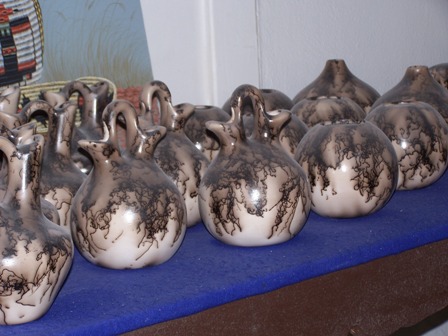
 A selection of detailed pottery
 This design is done completely by hand. The symmetry and straight lines look precise enough to be done by a machine.
 A sampling of shapes and designs.
 "Horse Hair" pottery. The curly lines are actually made with long horse hairs placed on the wet pottery and fired in the kiln. The horse hair is taken off later, leaving this pattern.
 A Junior Youth from the Querino group and a child from a Children's Class in Sanders admiring the pottery.
 A junior youth from the Houck group and a child from the Children's Class in Sanders.
And you might imagine it being a crazy, out-of-hand, lets-never-do-this-again kind of trip….but I was astonished at the level of maturity displayed by the junior youth throughout the four hours. They let their nobility shine as the group learned about various art forms and the ways in which artists make a living.
We first visited the New Mexico Pottery Company, where the junior youth were given a tour of the pottery-making process, from making slip to firing. Then we were treated to a tour of Chester Kahn’s Mural of Light artwork at the Ellis Tanner Trading Post, led by the artist himself.
A little background: The Mural of Light is a painted strip of portraits encircling the inside wall of the trading post. It portrays Navajo leaders beginning with the long walk up to the present. The mural took 7 years to paint, and about 2 weeks per portrait. The portraits were first drawn free hand by Chester based on photos, some of which were in black and white. He then meticulously painted in acrylic and oil, and with incredible life and detail.




Children's Class: Blue Corn Mush Demonstration
After attending a cultural celebration day at Pine Springs High School and watching the Miss Pine Springs contest, where girls share their traditional talents, staff and volunteers at NABI decided to invite the new Miss Pine Springs to a Thursday Children’s Class to share her mush-making skills! The following are pictures and explanations of a demonstration on how to make a traditional Navajo dish: blue corn mush.
 Miss Pine Springs scoops out the blue corn meal. She will also add cedar ash to the boiling mixture to increase the blue color of the mush.
 This particular Children's Class takes place every Thursday as a part of Thursday community dinner at NABI. The community arrives at 5PM for prayers, then children and junior youth break out into their classes, then all gather again for dinner at 6.
 The final product. The ingredients: boiling water, blue corn meal, and cedar ash. Individuals can add their own salt, butter, or sugar after it is served. Blue corn meal can also be made into pancakes.
This activity is part of an ongoing effort in the community to bring cultural education into the Children's Classes and Junior Youth Groups. This endeavor includes asking grandparents to give demonstrations on language, cooking, and storytelling.


This activity is part of an ongoing effort in the community to bring cultural education into the Children's Classes and Junior Youth Groups. This endeavor includes asking grandparents to give demonstrations on language, cooking, and storytelling.
Monday, October 31, 2011


Tuesday, October 18, 2011
Brilliant Stars
A photographic representation of some Children's Classes in Fort Defiance and Houck
Prayer for Children: "O God, guide me, protect me, make of me a shining lamp and a brilliant star. Thou art the Mighty and the Powerful."
'Abdu'l-Baha
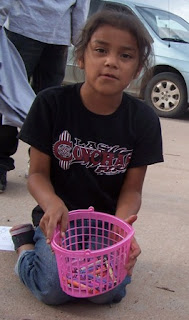

"O Friend! In the garden of thy heart, plant naught but the rose of love." Baha'u'llah, Lesson 3 of Children's Class material

 Something about chihuahuas and Children's Classes, they seem to mix well...

"O Son of Spirit! My first counsel is this: Possess a pure, kindly, and radiant heart." Baha'u'llah, memorization in Lesson 1 of Children's Class material

"Blessed is he who preferreth his brother before himself." Baha'u'llah, memorization in Lesson 6 of Children's Class material

Prayer for Children: "O God, guide me, protect me, make of me a shining lamp and a brilliant star. Thou art the Mighty and the Powerful."
'Abdu'l-Baha
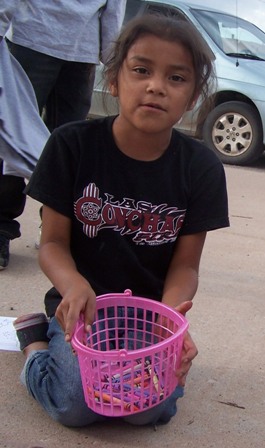

"O Friend! In the garden of thy heart, plant naught but the rose of love." Baha'u'llah, Lesson 3 of Children's Class material


"O Son of Spirit! My first counsel is this: Possess a pure, kindly, and radiant heart." Baha'u'llah, memorization in Lesson 1 of Children's Class material

"Blessed is he who preferreth his brother before himself." Baha'u'llah, memorization in Lesson 6 of Children's Class material

Monday, October 3, 2011
Year of Service Interview: Australia (2)

The Baha'i House of Worship in Australia
5.What are some pointers you would give to those looking to do a year or shorter period of service?
I think going in with an open mind and heart is the most important thing for service. Going with a pure motive to just serve God, everything else will fall into place. It’s amazing all of the different people I met. I truly feel like I was given the opportunity to go to Australia because I was meant to be there at that time with those specific people. I think the bottom line is to just do it. School will always be there, and work too, but a chance to go serve as a youth won’t always be an opportunity someone can take.
6. What were your living arrangements?
At the House of Worship in Sydney they have youth houses set up for service youth to stay in. So in my application process they scheduled me to live in the girls youth house for nine months.
7. Describe an average day on your year of service.
An average day is hard to describe because my roles and jobs kept changing as I was there. Being at the temple was a very special opportunity because there are many jobs that youth can do. First, I started guiding and gardening, then bookstore and reception work. Most days went from 8am-5pm. With gardening, we usually raked the path, pulled weeds, planted flowers or plants, cleaned the shed, and cleaned the office and the visitors’ center. These tasks were rotated throughout the week, so each day was a different task. With guiding, that’s when we would talk to the visitors that would come to the temple about the Baha’i Faith, and the temple itself. Bookstore work was mainly selling books to the visitors, and also re-shelving new books. As a receptionist I was taking in calls to the National Baha’i Office, and transferring them to different departments, along with replying to emails, and sorting mail. All of these jobs happened during the day, and so during the evening many of the service youth would participate in community activities. We set up a regular devotional gathering, a few Ruhi study circles, children’s classes, and participated in the children’s classes that are taught in state schools, that’s called BESS (Baha’i Education in State Schools). So there weren’t too many ‘average’ days. My schedule frequently changed the longer I stayed.

Sunday, October 2, 2011
Year of Service Interview: Australia
The following is the first of many interviews to come with other youth around the world who have been on a year of service. I post these interviews specifically for other youth contemplating doing their own year of service who don't know yet where they want to go or if they should go. The interviews hopefully shed light on some of the questions that arise for those seeking the life-changing adventures that a year of service can offer.
The Baha’i youth featured in the below interview chose to serve for a year in Australia. She is now in college and serving her community in Colorado. I know you will enjoy her comments and insights into the true meaning of service.

Youth serving at the House of Worship in Australia
1. What drew you to Sydney, Australia as a place to serve?
When I was looking for places to serve, I really wasn’t set on anywhere specific. I knew I wanted to go internationally, but I didn’t know where. So I started with Google, and looked up “Baha’i youth year of service”. As I was reading through the lists, Australia just seemed to keep popping up. So the more I thought about going to Australia, the more I liked the idea. I looked online at the Australian Baha’i National website, and found the application, and applied. The next thing I knew I had a phone interview and was accepted to serve. I felt that it being such a smooth process was a confirmation of my choice to go to Sydney.
2. How has your life changed as a result of service?
Everything about my life changed after my year in Australia. After high school, I needed a break from school, and I had heard so many wonderful stories from friends that had done a year of service, and how life changing it was for them. I had no idea what I was getting myself into, but I decided to take the risk and travel all the way across the world by myself. By being able to dedicate my full time to service, I was able to see the true necessity of a community based on service to each other. Since I was at a Baha’i House of Worship in Sydney, I was able to pray there every day and contemplate about my life and future. As my year in Australia drew to a close, I realized how much I had grown in that year and become more aware of my own personal strengths and weaknesses. Also, being able to travel outside of the country I had grown up in gave me a better view of the world around me.
3. What was the greatest test you faced and how did you overcome it?
For me I didn’t really have one big test that I had to overcome. There were some conflicts that arose while being in a small house with seven other girls, but those were resolved through communication and organization. I guess another thing that was stressful for me was the fact that my plan for school after Australia completely changed while I was there. So instead of knowing exactly what I was doing when I got back to the U.S., I had to figure it out while I was still in Australia. In retrospect, it doesn’t seem like a huge test, but I know while I was there it was definitely stressful.
4. What was your happiest moment on your year of service?
I distinctly remember going into the House of Worship by myself at night, and just the feeling of peacefulness and serenity I will never forget. Being able to go and say as many prayers as I wanted, and just being able to feel that spirit was such a beautiful thing. I can remember a specific time when my service had reached an especially stressful point, and I went and said the Tablet of Ahmad on each of the nine sides. As I continued to pray I could feel my worries and fears just melt away.
To be continued….
The Baha’i youth featured in the below interview chose to serve for a year in Australia. She is now in college and serving her community in Colorado. I know you will enjoy her comments and insights into the true meaning of service.

Youth serving at the House of Worship in Australia
1. What drew you to Sydney, Australia as a place to serve?
When I was looking for places to serve, I really wasn’t set on anywhere specific. I knew I wanted to go internationally, but I didn’t know where. So I started with Google, and looked up “Baha’i youth year of service”. As I was reading through the lists, Australia just seemed to keep popping up. So the more I thought about going to Australia, the more I liked the idea. I looked online at the Australian Baha’i National website, and found the application, and applied. The next thing I knew I had a phone interview and was accepted to serve. I felt that it being such a smooth process was a confirmation of my choice to go to Sydney.
2. How has your life changed as a result of service?
Everything about my life changed after my year in Australia. After high school, I needed a break from school, and I had heard so many wonderful stories from friends that had done a year of service, and how life changing it was for them. I had no idea what I was getting myself into, but I decided to take the risk and travel all the way across the world by myself. By being able to dedicate my full time to service, I was able to see the true necessity of a community based on service to each other. Since I was at a Baha’i House of Worship in Sydney, I was able to pray there every day and contemplate about my life and future. As my year in Australia drew to a close, I realized how much I had grown in that year and become more aware of my own personal strengths and weaknesses. Also, being able to travel outside of the country I had grown up in gave me a better view of the world around me.
3. What was the greatest test you faced and how did you overcome it?
For me I didn’t really have one big test that I had to overcome. There were some conflicts that arose while being in a small house with seven other girls, but those were resolved through communication and organization. I guess another thing that was stressful for me was the fact that my plan for school after Australia completely changed while I was there. So instead of knowing exactly what I was doing when I got back to the U.S., I had to figure it out while I was still in Australia. In retrospect, it doesn’t seem like a huge test, but I know while I was there it was definitely stressful.
4. What was your happiest moment on your year of service?
I distinctly remember going into the House of Worship by myself at night, and just the feeling of peacefulness and serenity I will never forget. Being able to go and say as many prayers as I wanted, and just being able to feel that spirit was such a beautiful thing. I can remember a specific time when my service had reached an especially stressful point, and I went and said the Tablet of Ahmad on each of the nine sides. As I continued to pray I could feel my worries and fears just melt away.
To be continued….
Sunday, September 25, 2011
Camping in Canyon de Chelly
Unless guided by a Navajo or certified park guide, all visitors to Canyon de Chelly must be satisfied with a drive along the top of the canyon and stops at overlooks, each of which are striking and breathtaking in beauty. Thanks to a Navajo Baha’i family with land in the canyon, a few NABI staff and volunteers had the bounty of spending a night in the canyon.

Spider Rock, home of Spider Woman, who taught the people how to weave
A few of us hiked down while others drove in with a truck loaded with food, water, and tent gear. Those who hiked experienced a rubble-strewn and occasionally steep trail which bottomed out and followed a creek bed along the canyon’s base. The creek bed was overgrown with tamarisk and Russian olive, and Western Bluebirds flew over our heads in small flocks as we walked. A Red-tailed Hawk let out a scream, no doubt sitting on a canyon ledge, the rust red of its tail complimenting the terra cotta canyon walls. As we walked along our guide pointed out the dark streaks along the canyon walls, called desert varnish. The Navajo say these streaks are the canyon’s hair. Our guide told us that if a girl washes her hair in the water which collects in the natural wells on the canyon top, it is said her hair will grow long like the canyon’s.

After setting up our tents, another volunteer and I played our flutes at different points near the campsite. The sound of our flutes echoed across the canyon. Then we all had a dinner of Navajo tacos (after learning how to make fry bread). And of course, we made s’mores. Anna Feria, programs coordinator at NABI, taught us to make chocolate bananas over the fire (see instructions below). We spent the night singing and talking as the moon cast its warm glow over the canyon walls. Now that’s what I call a perfect night, spent with kindred spirits. :)
I’m Buildin’ Me A Home (part of a song we learned at trainings in Pheonix):
If you see me praying
I’m buildin’ me a home
Well if you see me praying
I’m buildin’ me a home
Cuz this earthly house
Is gonna soon decay
And I’ve got to have
Some place to stay

Rae and Nani at the campfire
* How to make a chocolate bananaphone! Perfect for camping trips (could be used in junior youth group activities, especially sleepover events). It may be helpful to place a grill over the fire, although the bananas can be placed directly on coals. Cut banana on the inside of the bend to create a space where you can wedge chocolate chunks inside. Use broken up Hershey bar or other chocolate to place inside the cut. Wrap banana in aluminum foil (do not take the skin off!) and place over fire or coals. Let cook until chocolate is melted on the inside. Use spoon to scoop chocolate-banana gooeyness out of the skin.

Spider Rock, home of Spider Woman, who taught the people how to weave
A few of us hiked down while others drove in with a truck loaded with food, water, and tent gear. Those who hiked experienced a rubble-strewn and occasionally steep trail which bottomed out and followed a creek bed along the canyon’s base. The creek bed was overgrown with tamarisk and Russian olive, and Western Bluebirds flew over our heads in small flocks as we walked. A Red-tailed Hawk let out a scream, no doubt sitting on a canyon ledge, the rust red of its tail complimenting the terra cotta canyon walls. As we walked along our guide pointed out the dark streaks along the canyon walls, called desert varnish. The Navajo say these streaks are the canyon’s hair. Our guide told us that if a girl washes her hair in the water which collects in the natural wells on the canyon top, it is said her hair will grow long like the canyon’s.

After setting up our tents, another volunteer and I played our flutes at different points near the campsite. The sound of our flutes echoed across the canyon. Then we all had a dinner of Navajo tacos (after learning how to make fry bread). And of course, we made s’mores. Anna Feria, programs coordinator at NABI, taught us to make chocolate bananas over the fire (see instructions below). We spent the night singing and talking as the moon cast its warm glow over the canyon walls. Now that’s what I call a perfect night, spent with kindred spirits. :)
I’m Buildin’ Me A Home (part of a song we learned at trainings in Pheonix):
If you see me praying
I’m buildin’ me a home
Well if you see me praying
I’m buildin’ me a home
Cuz this earthly house
Is gonna soon decay
And I’ve got to have
Some place to stay

Rae and Nani at the campfire
* How to make a chocolate bananaphone! Perfect for camping trips (could be used in junior youth group activities, especially sleepover events). It may be helpful to place a grill over the fire, although the bananas can be placed directly on coals. Cut banana on the inside of the bend to create a space where you can wedge chocolate chunks inside. Use broken up Hershey bar or other chocolate to place inside the cut. Wrap banana in aluminum foil (do not take the skin off!) and place over fire or coals. Let cook until chocolate is melted on the inside. Use spoon to scoop chocolate-banana gooeyness out of the skin.
Poem: Morning Prayer

See the sun rays through the clouds,
The distant and misty rainbow.
Hear the gentle pitter-patter of the rain,
The thump of jackrabbit's over-sized feet,
Like a heartbeat against the Earth
As he races over the red-clay land.
Smell the dampened sage,
Let the sticky clay cling lovingly
To your humble sandals
Which have walked so far.
Now let us pray with radiance:
Creator, give this yearning heart
Hope to carry forward and courage
She is certainly the weakest creature
In this dust-ridden land
And like dust, will one day be blown
By the unexpected storm to
Far-away places
We grow with pain
Our souls thrive
After being uprooted
So give her detachment
From all things
Even the home
Even her dreams
She has become the eagle
Which soars over vistas and canyons
The beloved sun illuminating her wings
As she longs to come closer to its
Warming rays,
She is nearing its radiance
Yet infinitely far from the object
Of her desire.
Yes, her body is a hindrance
A mere cage
From which the bird of her soul
Longs to break lose
And stretch its wings
Let us pray with radiant yearning:
Illuminate our every action
O True Friend
We will all return to beauty
Hozho nahasdlii
Hozho nahasdlii
Hozho nahasdlii
Hozho nahasdlii
Thursday, September 22, 2011
Artwork!!
Both need a lot of improvements, but here they are, from a girl who used to think she couldn't draw humans at all:
 Navajo girl, watercolor
 Radiant drummers, pen and ink


Subscribe to:
Posts (Atom)